
This manual serves as a comprehensive guide, assisting users in mastering the functions and capabilities of their physics lab equipment.
It’s designed for effective learning, aligning with NCERT/CBSE curricula and providing practical experiment support for students.
Purpose of the Manual
This manual’s primary goal is to empower students with a thorough understanding of physics principles through hands-on experimentation. It bridges theoretical knowledge with practical application, fostering a deeper comprehension of concepts.
Furthermore, it aims to provide clear, step-by-step instructions for conducting experiments, ensuring safety and accuracy. Aligned with NCERT/CBSE guidelines, it supports effective lab work and prepares students for practical assessments, ultimately enhancing their overall physics proficiency.
Target Audience
This physics lab manual is specifically designed for secondary and higher secondary students – those in Classes 11 and 12 following the NCERT/CBSE curriculum. It caters to both beginners seeking foundational knowledge and those aiming to refine their practical skills.
Additionally, it serves as a valuable resource for educators, providing a structured framework for conducting physics experiments and assessing student understanding effectively.

Essential Lab Equipment
A well-equipped physics lab necessitates tools like multimeters, oscilloscopes, power supplies, rulers, calipers, and protractors for accurate measurements and experimentation.
Multimeters and Oscilloscopes
Multimeters are fundamental for measuring voltage, current, and resistance, providing crucial electrical data. Oscilloscopes visualize electrical signals over time, displaying waveforms for detailed analysis of frequency and amplitude.
These instruments are essential for verifying circuit behavior, troubleshooting, and understanding signal characteristics. Proper usage and calibration are vital for obtaining reliable and accurate experimental results within the physics laboratory setting.
Power Supplies
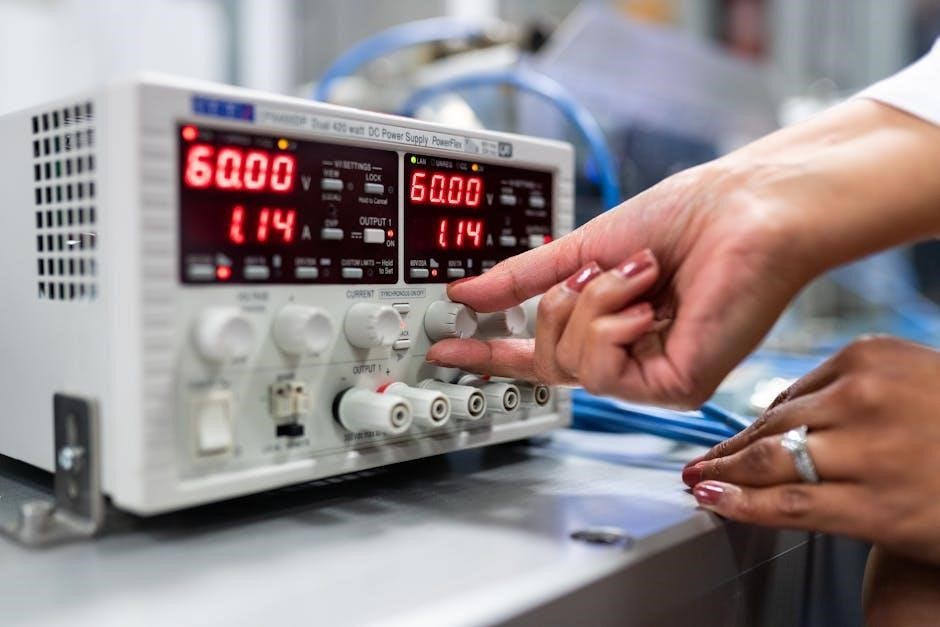
Power supplies deliver stable DC voltage and current to circuits, enabling controlled experimentation. Adjustable models allow varying power levels, crucial for testing component behavior under different conditions.
Understanding voltage and current limitations is paramount to prevent damage to equipment. Safe operation and proper grounding are essential when utilizing power supplies within the physics lab environment for accurate results.
Measurement Tools (Rulers, Calipers, Protractors)
Precise measurements are fundamental in physics. Rulers measure length, while calipers offer higher precision for object dimensions. Protractors accurately determine angles, vital for mechanics and optics experiments.
Understanding the limitations and proper usage of each tool is crucial for minimizing errors. Consistent units and careful readings ensure reliable data collection and analysis within the lab.

Basic Measurement Techniques
Mastering measurement involves understanding units, dimensions, significant figures, and error analysis for accurate data recording and effective graphical representation.
Units and Dimensions
Precise measurements rely on standardized units – the International System of Units (SI) is paramount. Understanding dimensions, like length, mass, and time, is crucial for equation consistency.
Always express quantities with their correct units (meters, kilograms, seconds). Dimensional analysis verifies equation validity, preventing errors. Proper unit conversion is essential for accurate calculations and reporting experimental results, ensuring clarity and reproducibility.
Significant Figures and Error Analysis
Accurate reporting demands understanding significant figures, reflecting measurement precision. Error analysis identifies both random and systematic uncertainties impacting results.
Calculate percentage errors to quantify experimental deviations. Propagation of errors determines uncertainty in calculated values. Clearly stating uncertainties alongside results demonstrates scientific rigor and acknowledges limitations inherent in all measurements, fostering transparency.
Data Recording and Graphing
Meticulous data recording is crucial; use organized tables with clear units. Graphing visually represents relationships between variables, aiding analysis and interpretation.
Select appropriate graph types – line, bar, or scatter – based on data characteristics. Properly label axes, include a title, and determine the equation representing the trend. Accurate graphical representation enhances understanding and supports conclusions.
Mechanics Experiments
Explore fundamental principles like Newton’s Laws, projectile motion, and energy conservation through hands-on experiments. These labs solidify theoretical understanding.
Newton’s Laws of Motion
Investigate Newton’s three laws through practical experiments, verifying the relationship between force, mass, and acceleration. Labs include analyzing motion on inclined planes and utilizing dynamics carts.
Students will quantitatively determine acceleration due to gravity and explore concepts like friction. Data analysis and graphical representation are crucial components, reinforcing theoretical concepts with empirical evidence.
Projectile Motion
Explore the principles governing projectile trajectories through experiments launching objects at various angles. Determine initial velocity components and calculate range, maximum height, and flight time.
Analyze the influence of gravity on motion, neglecting air resistance for simplified calculations. Data collection involves precise measurements, fostering understanding of parabolic paths and independent horizontal/vertical movements.
Conservation of Energy
Investigate energy transformations between potential and kinetic forms using systems like pendulum swings or rolling objects down inclines. Quantify energy loss due to non-conservative forces, like friction.
Measure initial and final energies, verifying the principle of energy conservation. This experiment reinforces understanding of work, energy, and their relationship, crucial for advanced physics concepts.

Thermal Physics Experiments
Explore heat transfer, specific heat capacity, and thermal equilibrium through practical experiments. Understand mechanisms like conduction, convection, and radiation effectively.
Specific Heat Capacity
Determine the specific heat capacity of various materials – solids and liquids – using calorimetry. This experiment involves measuring temperature changes when heat is added or removed.
Students will learn to apply the formula Q = mcΔT, where Q is heat, m is mass, c is specific heat capacity, and ΔT is the temperature change. Accurate data recording and analysis are crucial for reliable results, enhancing understanding of thermal properties.
Heat Transfer Mechanisms
Investigate conduction, convection, and radiation – the three primary modes of heat transfer. Experiments may involve measuring temperature gradients across different materials (conduction), observing fluid movement (convection), and quantifying radiative heat exchange.
Students will analyze how these mechanisms affect thermal equilibrium and explore their applications in everyday phenomena, solidifying their grasp of thermodynamics and energy transfer principles.

Electricity and Magnetism Experiments
Explore Ohm’s Law, resistance, and magnetic fields through practical experiments. This section provides hands-on experience with electrical circuits and magnetic phenomena.
Ohm’s Law and Resistance
This experiment focuses on verifying Ohm’s Law through practical measurements of voltage, current, and resistance in various circuits. Students will learn to construct simple circuits, utilize multimeters for accurate readings, and calculate resistance using the formula R = V/I.
Furthermore, the lab explores factors affecting resistance, like material type and length, providing a foundational understanding of electrical conductivity and circuit behavior.
Magnetic Fields
This section guides students in visualizing and mapping magnetic field lines using compasses and iron filings around bar magnets and current-carrying wires. Experiments will demonstrate the interaction between magnetic poles and the influence of current on magnetic fields.
Students will quantitatively analyze magnetic force and explore its applications, solidifying their understanding of electromagnetism’s fundamental principles.

Optics Experiments
This section focuses on practical applications of reflection, refraction, and lens/mirror formulas, enabling students to explore light’s behavior and optical instruments.
Reflection and Refraction
These experiments investigate the fundamental laws governing how light interacts with surfaces. Students will meticulously measure angles of incidence and reflection, verifying the law of reflection with mirrors.
Furthermore, they’ll explore refraction – the bending of light – as it passes through different media, calculating refractive indices and observing phenomena like total internal reflection. Precise measurements and careful observation are key.
Lens and Mirror Formula
This section focuses on experimentally verifying the lens and mirror formulas – crucial equations relating object distance, image distance, and focal length. Students will determine focal lengths of lenses and mirrors through careful measurements.
They’ll analyze image characteristics (real/virtual, magnified/diminished) and understand how these relate to the formula’s parameters, solidifying their understanding of geometrical optics principles.

NCERT/CBSE Curriculum Alignment
This manual directly supports NCERT and CBSE physics lab experiments for Classes 11 and 12, offering practical exercises and downloadable resources.
Class 11 Physics Lab Experiments
Class 11 experiments focus on foundational physics principles. Students will verify laws of motion, explore measurement accuracy using various tools, and investigate projectile motion dynamics.
Practical exercises include determining ‘g’ using a pendulum, studying the relationship between force and acceleration, and analyzing energy conservation in simple systems. Downloadable files provide detailed procedures and observation tables, aligning with the NCERT syllabus for effective learning and skill development.
Class 12 Physics Lab Experiments
Class 12 experiments build upon foundational concepts, delving into electricity, magnetism, and optics. Students will verify Ohm’s Law, explore magnetic field lines, and investigate lens properties.
Practical work includes determining the internal resistance of a cell, studying the characteristics of semiconductors, and analyzing diffraction patterns. Direct download links to NCERT lab manuals provide detailed guidance for successful completion of practical assessments and a deeper understanding of physics.
Safety Precautions in the Physics Lab
Prioritize safety by adhering to general and electrical safety rules. Proper handling of equipment and awareness of potential hazards are crucial for a secure lab environment.
General Lab Safety Rules
Always wear appropriate personal protective equipment, including safety goggles, to shield your eyes from potential hazards. Maintain a clean and organized workspace, free from obstructions, to prevent accidents.
Familiarize yourself with the location of safety equipment like fire extinguishers and first aid kits. Never eat, drink, or apply cosmetics in the lab. Report any spills or broken equipment immediately to the instructor.
Follow all instructions carefully and ask questions if unsure about any procedure.
Electrical Safety
Before operating any electrical equipment, inspect cords for damage and ensure proper grounding. Never work with electricity near water or with wet hands, as this significantly increases the risk of shock.
Always disconnect equipment from the power source before making any adjustments or repairs. Avoid touching exposed wires or terminals. Report any malfunctioning electrical equipment immediately.
Understand the purpose of fuses and circuit breakers and never bypass them.
Troubleshooting Common Lab Issues
This section details solutions for equipment malfunctions and experimental errors, ensuring smooth operation and accurate results within the physics laboratory setting.
Equipment Malfunctions
Addressing equipment issues is crucial for successful experiments. Common problems include power supply failures, multimeter inaccuracies, and oscilloscope display distortions. First, verify power connections and settings.
If a multimeter shows erratic readings, check the battery and fuse. For oscilloscopes, ensure proper probe calibration. Consult the equipment’s manual for specific troubleshooting steps and seek assistance if problems persist, prioritizing safety always.
Experimental Errors
Understanding error sources is vital for accurate results. Systematic errors, like instrument flaws, consistently skew data. Random errors, from reading inaccuracies, cause unpredictable variations.
Minimize errors through careful calibration, repeated measurements, and proper technique. Error analysis, including significant figure consideration, quantifies uncertainty. Documenting potential error sources enhances experiment validity and interpretation.
Appendix: Useful Formulas and Constants
This section provides essential physical constants and common equations for quick reference during experiments, aiding in calculations and data analysis.
Physical Constants
Essential constants underpin accurate calculations in physics experiments. This appendix lists key values, including the speed of light (c = 2.998 x 10⁸ m/s), gravitational constant (G = 6.674 x 10⁻¹¹ Nm2/kg2), and Planck’s constant (h = 6.626 x 10⁻³⁴ Js).
Additionally, we include the elementary charge (e = 1.602 x 10⁻¹⁹ C), Boltzmann constant (k = 1.381 x 10⁻²³ J/K), and Avogadro’s number (NA = 6.022 x 10²³ mol-1) for comprehensive support.
Common Equations
This section provides frequently used equations for quick reference during experiments. Key formulas include kinematic equations (v = u + at), Ohm’s Law (V = IR), and the gravitational force equation (F = Gm1m2/r2).
Further equations cover energy (KE = ½mv2, PE = mgh), wave speed (v = fλ), and refractive index (n = c/v), aiding in efficient problem-solving and data analysis within the lab setting.